

Research integrity
A brief introduction for those who are new to the topic.

What is research integrity?
Research integrity is about conducting research with rigour, transparency, and accountability, so that research outputs can be trusted as a reliable source of information.
Research integrity is the foundation of quality scholarship.
Principles of research integrity
Research integrity is a global concern. Different regions adopt different codes of practice, but there’s a lot of commonality between them. This diagram shows the principles named by selected research integrity codes, and illustrates the commonalities between them.
Ask yourself: If you could only name four principles, which four would you name? In other words, which principles do you think are the most important in promoting quality research?

Ultimately, what matters most is not the set of principles that we name, but the attitudes and practices that we adopt in our day-to-day research.
For example, the principle of ‘transparency’ is just a word that attempts to describe the ways that a researcher should act when they describe their methods, present their data, disclose a potential conflict of interest, promote their work in the media, and so on. In all of these activities, a researcher should be transparent. They should provide relevant details, and do so clearly and openly – with a view to fostering trust, reproducibility, and accountability.
-
In academic circles, there’s an interesting debate about whether research integrity is best described in terms of virtues or responsibilities. This debate relates to long-standing philosophical theories about ‘virtue ethics’ and ‘deontology’.
Both perspectives offer valuable insights.
Thinking about research integrity in terms of virtues emphasizes the character that researchers should seek to embody in their academic work. On this view, research integrity is about doing research with the right character and in the right spirit.
On the other hand, thinking about research integrity in terms of responsibilities helps us focus on the specific actions and obligations required by researchers in certain circumstances. This provides a common ground, and a clear set of expectations.
Regardless of the framing, the ultimate goal is the same, and the two approaches are probably consistent and mutually beneficial in the context of research integrity.
In any case, this short introduction will use a mix of those approaches, describing research integrity both in terms of the virtues that researchers should seek to embody, and the responsibilities that researchers have.
-
Most of these documents are only short. You might like to choose the one that’s most likely to apply to your region:
Beyond compliance
A common misconception is that research integrity is only about following basic rules and policies. That’s sometimes how research integrity is taught, which makes it appear very boring.
True, it’s vital to comply with laws and policies governing research. Researchers must learn what those are, and that’s part of research integrity.
But, more broadly, we should approach research integrity with an academic mindset, just as we approach other aspects of scholarship. We should understand why research integrity is vitally important, how it relates to the quality of the work that we produce, and how we can do it best.

We are discussing no small matter, but how we ought to live do research.
PLATO, REPUBLIC (1.352d), QUOTE EDITED TO MAKE A POINT
In fact, research integrity addresses complex ethical challenges that are fundamental to quality scholarship, for example:
What are trustworthy methods for analysing and presenting data?
In a world with artificial intelligence, what is ‘originality’ and what is ‘plagiarism’?
How transparent should we be about our data and methods?
To what extent do the incentive structures of academia contribute to poor practices? How can we make them better?
What is the purpose of peer review and how can we ensure that our systems of critique promote rigour?
How can we avoid undue bias and conflicts of interest so that research findings can be trusted?
Trustworthy research
One useful way to think about research integrity is to ask, “When can we trust academic research as a reliable source of information?”
Some of the answers to this question will be about the ways that researchers should act, and the ways that research should be reported and critiqued. Here are several examples.
Trustworthy research employs appropriate methods for discovering new knowledge.

Trustworthy research is characterised by rigour and attention to detail.

Trustworthy research is clearly described and can be replicated or reproduced.

Trustworthy research is open to ongoing scholarly critique.

Trustworthy research is transparent in acknowledging funding sources and potential conflicts of interest.


A fruitful research culture
Research integrity also relates to the environments in which research is conducted.
Consider: What sort of research culture is best at producing reliable knowledge? What sort of academic environment would you like to be a part of?
Here are some ideas for your consideration.
A fruitful research culture promotes and rewards good practices.

A fruitful research culture fosters scholarly freedom and robust debate.

A fruitful research culture is characterised by respect for fellow academics and the public.

A fruitful research culture is accountable for the research it produces.

A fruitful research culture is fair and equitable in proportioning credit, funding, and career opportunities.

Integrity at different levels
Of course, there’s a strong relationship between the things we have been considering so far – that is, between the quality of research and the culture of research. And both of those are impacted by the broader environments in which research occurs: reward systems, infrastructure, publishing models, funding mechanics, and politics.
So, when we’re thinking about research integrity, we need to consider how it applies to various interrelated scales: to each of us, to our academic culture, and to our broader scholarly ecosystem.

Each of us
How can you act with integrity in the research environment? How will you embody the virtues of a rigorous and ethical researcher?

Our culture
How can we foster a culture in which quality research is valued and recognized, and in which our standard practices are all good practices.

Our infrastructure & systems
How can we structure our academic systems, policies, funding, and career incentives such that good research practices are easy, rewarded, and required?

For reflection or discussion
-
The examples given above are by no means exhaustive. Is there anything you would like to add about what makes for trustworthy research or what contributes to a fruitful research culture?
-
Have you heard any stories about failures of research integrity in the news?
What happened? What did the researchers do wrong? Why do you think they did it? What were the consequences?
-
Imagine that someone obeys all the ‘rules’ of research. They comply with every law and every policy.
On this basis, would you say that researcher must therefore conduct their work with integrity?
Why, or why not?
Research integrity in practice
Let’s consider a few examples of research integrity in practice.
Peer review
Robust critique is one of the hallmarks of quality research. At its best, peer review helps ensure the rigour, accuracy and reliability of research. It provides a mechanism for quality control for funding bodies, institutions, and publishers, and helps improve the quality of scholarly outputs. It gives confidence to the public, and to industry.
To ensure it works well, we must engage responsibly with peer review – both as reviewers, and as researchers under review.

-
When you’re conducting a review:
Be honest, professional, scholarly and constructive.
Maintain confidentiality (wherever that is required). Do not contact the authors or other reviewers unless authorised to do so.
Do not take advantage of confidential information that you acquire as part of your review for your own benefit. As Bourne and Barbour write, "...we often agree to review a paper because we imagine we will learn from the experience. That is fine. Where it crosses the line is when it could be perceived by someone that you are competing with the person whose work you are reviewing and have more to gain than just general knowledge from reviewing the work. There is a grey area here of course, so better to turn down a review if not sure."
Understand the criteria you have been asked to apply and conduct your review according to those criteria. If your expertise does not extend to a particular element of the criteria, make that clear to the editor.
Conduct your review impartially and objectively to the best of your ability. Disclose any conflicts of interest transparently. Do not let personal prejudices or biases affect your review. Don't request that the authors cite your own work (unless there is an objective scholarly reason that they should do so).
Be timely. Communicate about any delays with the editor. Never intentionally delay a review process.
Consider mentoring trainees. If you have permission from the editor, you could work together with students or other research trainees to teach them how to conduct an effective peer review.
-
If your work is under review:
Maintain confidentiality (wherever that is required).
Do not interfere in the peer review process.
When you respond to comments, be professional.

Read one of these papers to learn more about peer review and its relationship to research integrity. Beyond our basic personal responsibilities, we should also consider which models of peer review promote objectivity, transparency, accountability, and rigour.
Rodríguez-Bravo, B., et al. (2017) “Peer review: The experience and views of early career researchers: Peer review and early career researchers”. Learned Publishing
Gerwing, T.G., et al. (2020) “Quantifying professionalism in peer review”. Research Integrity and Peer Review
Noble, W.S. (2017) “Ten simple rules for writing a response to reviewers”. PLoS Computational Biology
Tennant, J. P., et al. (2017) “A multi-disciplinary perspective on emergent and future innovations in peer review”. F1000Research
Mebane, C. A. (2024) “Double-blind peer review is detrimental to scientific integrity”. Environmental Toxicology and Chemistry
Smith, R. (2006) “Peer Review: A Flawed Process at the Heart of Science”. Journal of the Royal Society of Medicine
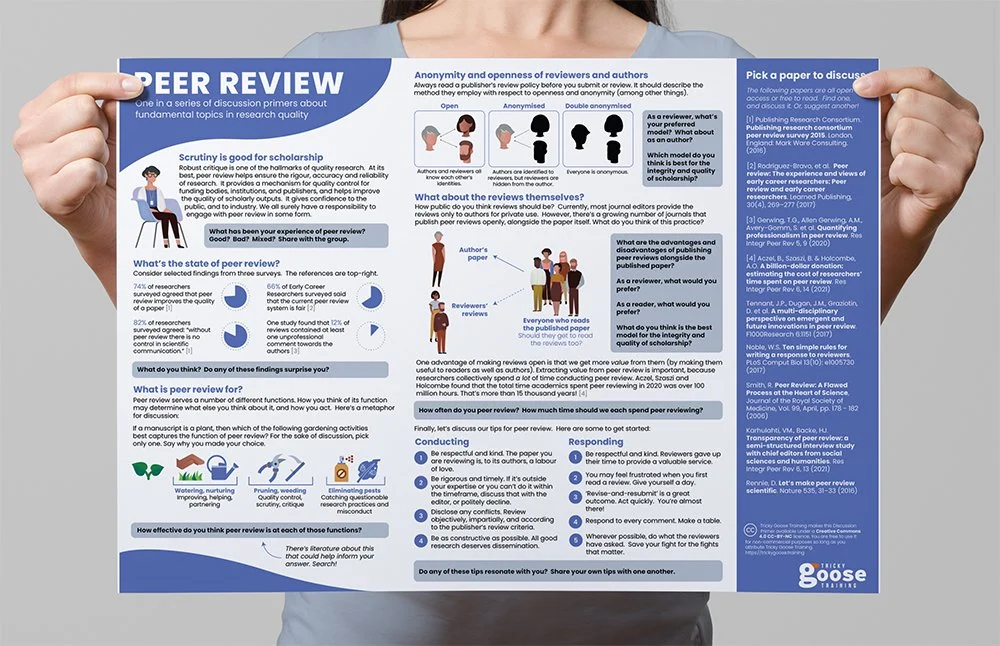
You may also like to download our printable (A3) Peer Review Discussion Primer, and chat about it with fellow students or colleagues.
Reproducibility
Suppose you read about an accepted scientific finding in a reputable journal. You might expect that if you tried to reproduce its experiments, using the same methods, under the same conditions, then you would find similar results.
Indeed, the belief that (most) scientific work should be reproducible in that sense is one of the reasons that we trust the findings of research.
In terms of research integrity, reproducibility relates to the principles of rigour and transparency. We must use robust methods, employ them carefully and with attention to detail, report the findings irrespective of what they are, and describe the work clearly and openly. These practices increase reproducibility, and increase trust.

-
By 2016, reproducibility was a hot topic in scholarship, and there was a growing concern that many accepted findings couldn't be reproduced at all. Some people even called this a "reproducibility crisis".
Monya Baker conducted a survey of 1,576 scientists about reproducibility. She asked, “Is there a reproducibility crisis?”
They responded:
Yes, a significant crisis (52%)
Yes, a slight crisis (38%)
Don’t know (7%)
No, there is no crisis (3%)
Somewhat strangely, Baker found that “...although 52% [agreed] that there is a significant 'crisis' of reproducibility, less than 31% [thought] that failure to reproduce published results means that the result is probably wrong, and most say that they still trust the published literature.”
How would you respond?
Research waste
There’s a real concern that much research is wasted. In 1994, Doug Altman observed that, "...huge sums of money are spent annually on research that is seriously flawed through the use of inappropriate designs, unrepresentative samples, small samples, incorrect methods of analysis, and faulty interpretation."
Chalmers and Glasziou [paywall] estimate that research wastage may be as high as 85%. That’s shocking. Given the importance of research to society, there’s a desperate need to do better.

-
Research waste is affected by the ways that researchers act and the attitudes they adopt.
There are things we can do. For example:
Publish all research findings impartially and irrespective of what we find. Consider that 50% of research is never published. [Chalmers and Glasziou | paywall] Unpublished research is, in a very real sense, wasted. One of the issues here is the common failure to publish "negative results" – cases where a study failed to find an "interesting" result, but nonetheless made findings that could be useful.
Choose the right methods and employ them rigorously.
This sounds obvious, but it is so fundamental that it is worth taking a step back to reconsider. How do we choose our methods? Do we ever consult a statistician or a an expert in our methods?
Write a protocol and stick to it. In this way, we conduct the work with objectivity. Register your protocol if that applies within your field. Pre-registration increases transparency, and therefore rigor.
Disseminate our work, openly and usefully. Wherever possible, we can publish data or code that a reader would need to replicate the work.
Research fraud
Research fraud is the deliberate fabrication, falsification, or misrepresentation of data, methods, or results in order to deceive the academic community and the public.
There’s a common view that research fraud is committed only by ‘a few bad apples’, or that it is limited to certain countries or cultures. That assumption, however, is very doubtful. An investigation by a publisher identified thousands of fake scientific papers involving authors from more than 70 countries.
A 2022 survey by Gopalakrishna, et al. of researchers in the Netherlands found that 1 in 12 admitted to having fabricated or falsified research at least once in the past three years.
-
Paper mills are malevolent companies that generate and sell manuscripts to researchers. They prey on the perverse incentive structures of academia by churning out fake science for profit.
Many researchers are under immense pressure to publish, so a place of authorship on an accepted paper is a commodity for which some desperate researchers are willing to pay.
It’s all very alarming. Paper mills pose a real problem for research integrity.
We have a nice video about paper mills that you may like to watch.
Authorship
Authorship is important. It’s one of the primary mechanisms by which researchers get credit for the work they do. So, we need to ensure that our academic system of authorship is fair, and that authors are accountable for their research outputs.
To meet these goals, two basic rules are almost universally accepted by universities and publishers.
An author of an academic publication must:
have made a scholarly contribution to the research, and
agree to be accountable.
The point is that credit and accountability should go hand-in-hand. Only the people who actually did the work deserve to be authors, and those same people must be able and willing to take responsibility for its quality.

Beyond those basic rules, authorship norms differ somewhat between disciplines. Read your local policies and understand the requirements of the journals in which you intend to publish.
You may like to choose one of the following resources to learn more.
Marušić, A., et al. (2011) “A Systematic Review of Research on the Meaning, Ethics and Practices of Authorship across Scholarly Disciplines”. PLoS One
Kharasch, Evan D., et al. (2021) “Authorship and Publication Matters: Credit and Credibility”. Anesthesiology
Cook, S. J., et al. (2021) “Ten strategies for avoiding and overcoming authorship conflicts in academic publishing”. FACETS
International Committee of Medical Journal Editors, “Defining the Role of Authors and Contributors”.
Frassl, M. A., et al. (2018) “Ten simple rules for collaboratively writing a multi-authored paper”. PLoS Computational Biology

-
The order of authorship can matter, since some positions (first author, last author) carry more prestige and credit. These norms differ quite substantially between academic disciplines.
Discussions about order are hard. They can feel daunting – especially if there are power dynamics, or if team members have different perspectives about their relative contributions. Here are some practical tips.
Discuss authorship early and often. Most disputes arise due to poor communication.
Understand disciplinary norms. Your collaborators may not share all of your own views about authorship, especially if they come from a different field or perhaps a different country.
Try to understand each person’s contribution to the research and the manuscript. You might like to use the CRediT taxonomy to list the kinds of contributions that will be made (or have been made) by each collaborator. Some journals use the CRediT format. (https://credit.niso.org/)
If you decide not to order by relative contribution, the group could agree to an alphabetical or random order. The contribution statement can describe what each person did. In some fields (e.g. mathematics) alphabetic ordering is common.
You could use an authorship ‘scorecard’. For example, you could make a basic spreadsheet that lists research contributions down the side, and each contributor across the top. As a group, make a ‘score’ for each person’s contribution to each component. (Search for examples online.)
If you still can’t agree, the group could ask a trusted third-party to mediate.
Keep a record of what you’ve agreed. This could be a formal agreement, but it doesn't need to be in all cases. For example, it might just be a summary of what was agreed at a team meeting, emailed to all research team members.
-
Consider that:
authorship disputes are common. In one survey of 6,673 respondents, nearly half (46.6%) reported disagreements regarding authorship naming. (Smith, E., et al. 2019)
sexism appears to bias authorship lists. "Even where raw publication counts seem to be equal between genders, close inspection reveals that, in certain fields, men predominate in the prestigious first and last author positions." (Chaoqun, N., et al. 2021)
researchers often over-estimate their own contribution to a research project. (Herz, N., et al. 2020)
Incentive structures that impact integrity
The incentive structures of academia matter very much – for our culture, for fairness and equity, and because the existing incentive structures of academia undoubtedly fuel shoddy scholarship and scientific fraud.
How can we do better? How should we assess researchers if we want to promote research quality and integrity? You may like to start by reading the Hong Kong Principles (2020), which were designed to ensure “that researchers are explicitly recognized and rewarded for behaviors that strengthen research integrity.”
Research assessment is a vital and very complex issue.
If you’re up for a challenge, download our printable (A3) Research Assessment Discussion Primer and chat about it with your fellow research students or colleagues.

That’s only the beginning…
We’ve considered some examples of the ways that common research practices relate to research integrity.
In fact, there are many other topics that are important and fascinating.
How do you decide where to publish your research, and why does that matter?
What happens when researchers have a potential conflict of interests?
How should we manage our data to ensure that it’s useful and reusable?
What about research participants and human ethics?
Is it acceptable to discuss research in the media (or on social media) prior to peer review?
…and so on.
This has only been a short introduction. We hope you found it useful.
If you’d like to offer feedback, please do contact us.
Would your organisation benefit from better training?
If you’re interested, we offer a far more in depth and engaging course that can be customised to suit your institution’s policies, preferences, and resources. It’s full of short videos, activities, quizzes, and infographic discussion primers. It runs in your institution’s Learning Management System, so you can track completions and issue certificates.
Find out why so many institutions are using it, and loving it.
